
Have you ever been added to a group-text over iMessage, WhatsApp, or any other texting-service app on your electronic devices? Have any of these asked you to click on a link to a random website, to then put in your email and password in order to access your information? I have, and these malicious phishing attempts is bothersome, and can cause some real harm, especially when targeted to a specific (mainly older) group.
I want to focus on the general concept of “phishing”, the category of which most scams fall under. These can include classic calls or texts from individuals who claim to be your bank, an insurance company, etc., to try and get you to divulge personal information to get money or other sensitive data. There is also the unfortunate circumstance of malicious malware being installed to devices if the person just so happens to download a file, link, app, or whatever it may be. This is mostly obvious to the younger crowd making it less likely for them to fall victim, however I have noticed that Baby Boomers to early Generation X individuals fall victim to these attempts far too often. My siblings and I before have had to inform our parents that the texts they recieve are not real, though they already do have their own prior assumptions about the authenticity. Even though a vast majority of individuals will not fall victim for such phishing attempts, all the scam artists need are a couple dozen then their business is successful.
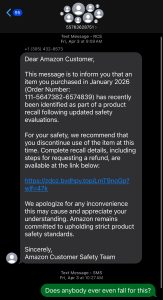
If you look at the picture I included within this blog post, this is a real text I got from someone trying to scam me, as well as 15+ others within a single iMessage group chat, to inform us that a recent purchase through Amazon has been recalled, and required us to visit a (totally suspicious) link to resolve it. . . I think it goes without say, what kind of automatic SMS messenger would include 15+ people to one group-chat?! It was completely idiotic (as you can tell by my response to the text), and I can only believe the MAIN PURPOSE of this phishing attempt is to get me to click on the link; put in my Amazon account information to a fake Amazon page, though I do not know what happens since I am smarter than that! Amazon accounts are extremely sensitive accounts that scam artists want immediate access to; they contain credit card information, personal addresses, and other personal information that is extremely easy to get to once a person has Amazon credentials.
There are a few signs of a scam text that makes it extremely easy to spot one. The first thing I recommend to people, and something I saw in the text message, is the phone number. The most common numbers I get sent phishing texts from are from area codes +62 and +880, their corresponding countries being Indonesia and Bangladesh. The MAIN rule I have is if the text message begins with a + and it is not followed with a 1, avoid the text message at all costs. As phishing attempts continue on, people start to realize that most scam artists come from India or Indonesia, so the scam artists have started to shift towards services such as “WeChat” or “TextNow”. These apps allow an individual to get a random, not in-service phone number to text or call any phone number they please to. This allows for simple and quick access for scammers to text people with an American phone number, essentially hiding their location (this works as long as the scammers have VPNs -which most don’t really think about in the first place-). To try and substitute a different option rather than looking at the phone number can get confusing, so if you ever get a text from a number stating that your account needs immediate attention; simply go onto the app or website through your phone or Google, and fix the problem that way. Don’t click on any links you cannot or do not trust!
These are some good pointers to spot scammers. Some scams really do look authentic. Remembering to look at where they are coming from is how how normally spot them (even though I’m an older Gen X’er)!
Awesome! I am glad that my pointers to spot a phishing text to be beneficial, nobody needs to go through the process of being scammed by anyone! Not all older people are susceptible, but scams are getting so much better now-a-days that you can never be too careful about what you click on. Remember, only trust the respected webstie/apps!
A group chat pops with a link to click,
A “recall” claim—a tired trick.
With fifteen strangers in the thread,
It’s best to leave that link unread.
From far-off codes, the scammers call,
To watch the weary “Boomers” fall.
But keep your head and stay the course:
Just check the app, and trust the source.
Thank you for the.. inspiring poem! I did not expect to see a poem underneath my blog, yet it coincides with exactly what I was talking about making it extremely creative! I have never seen a reply so unique, I want to know what made you think of this! Thank you again for the kind poem in response.
I remember when I got phished and lost my adult coloring book subscription. Those things look so authentic.
Unfortunately, this does tend to happen to individuals, but even more fascinating that you were able to lose a subscription. There are many different methods of scamming in today’s world, I wouldn’t doubt if you could be scammed out of a magazine subscription! Sorry to hear about your unfortunate experience being phished online, but I hope you are able to learn a little bit more on how to spot potential scams after reading my blog post!
Good article thank you for this information you seem like a lovely young man thank you. ive gotten phished before as a grandma but ive never fallen for them thanks to my grandson haha thank you
You are very welcome, I hope my blog post was able to teach you a little bit more on how to spot future phishing so you continue to stay un-scammed! As an elderly woman, you are usually the prime target for phishing scams to work especially when there is mention of personal assets at risk. My own grandmother got her very own “Dubai Prince” email demanding her to fork over $5,000. Luckily, she knew to ask her family first and she avoided being a victim of these phishing links.